-min.png)

.jpg)
In 2025, Saudi healthcare is no longer defined by size — it’s defined by speed. The leaders transforming hospitals and clinics today don’t just oversee staff or budgets — they orchestrate intelligent systems.
In 2025, Saudi healthcare is no longer defined by size — it’s defined by speed.
The leaders transforming hospitals and clinics today don’t just oversee staff or budgets — they orchestrate intelligent systems.
They know that digital isn’t enough anymore. The new edge is AI-augmented leadership.
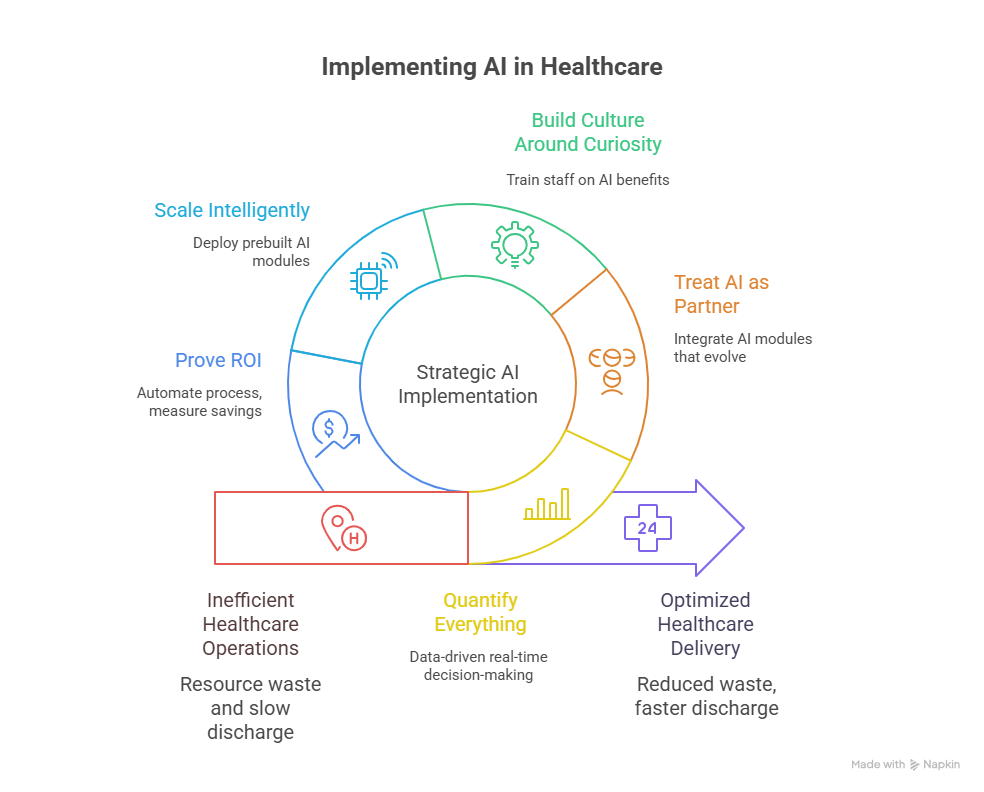
The smartest healthcare executives are data-driven — not just in reporting, but in real-time decision-making.
According to McKinsey’s 2024 State of Healthcare AI report, hospitals using predictive analytics for operations reduced resource waste by up to 20% and shortened patient discharge time by 30%.
These leaders don’t wait for weekly dashboards; they use AI agents to alert them when:
They turn insight into intervention.
Saudi context:
Hospitals aligning with Vision 2030’s Health Sector Transformation Program are expected to adopt data-driven care models that measure both patient outcomes and cost-effectiveness — a metric AI is now uniquely suited to optimize.
Legacy leaders “implemented systems.”
New leaders co-pilot with AI.
Instead of adding another software tool, they integrate AI modules that evolve with their needs:
The result:
Less firefighting. More foresight.
Accenture’s 2024 Health AI Index found that AI-assisted operations can recover up to three hours per clinician per shift through automation and real-time insights.
Ask any modern healthcare CEO in Riyadh or Boston — their biggest challenge isn’t adoption; it’s alignment.
Teams resist AI when it feels like surveillance.
They embrace it when it feels like superpower.
Smart leaders train their staff not on “how to use AI,” but on “how AI makes your job better.”
For example:
This turns AI from a tool into a trusted assistant.
New healthcare leaders think in systems, not silos.
Instead of building from scratch, they partner with companies like TechVention to deploy prebuilt AI modules that integrate into existing workflows — from EHRs to revenue cycle systems.
This modular approach allows scaling from one clinic to many, without the chaos of reimplementation.
It’s how Riyadh’s fastest-growing networks are expanding to multiple branches without losing patient experience quality.
According to HIMSS data (2025), hospitals using modular AI integration achieved 48% faster go-lives than those building in-house systems.
Great healthcare leaders don’t just pitch technology; they show ROI.
They start small:
This “proof-first” approach wins trust from boards, investors, and staff alike.
It shifts AI from being a buzzword to being the backbone of strategy.
Saudi Arabia’s healthcare system is uniquely positioned — Vision 2030 has already created digital infrastructure through NPHIES, Seha Virtual, and unified health data policies.
The missing piece?
Leaders who can bridge clinical intuition with computational intelligence.
That’s what the new healthcare leaders are doing right now.
They’re not waiting for global models — they’re creating their own.
Before your next leadership meeting, ask these three questions:
Start there — and you’re already leading smarter.
At TechVention, we build prebuilt AI modules that help hospitals and clinics lead with intelligence — not guesswork. The new healthcare leaders aren’t managing hospitals — they’re engineering outcomes. From Riyadh to San Francisco, the shift is clear: digital transformation is no longer the goal; intelligent transformation is.



